Volume 26 • No 02 • 2003
ISSN 0742-468X • Since 1978
On-line Since 2000
GMCS Market Study Excerpts
Part 2 (of 3)
Editor’s Note: In the last issue I provided excerpts from the Executive Summary of the definitive study of GIS & Mobile Computing Solutions (GMCS) for the North American Electric Utility Marketplace. The study was conducted by InfoNetrix (www.InfoNetrix.com), a market research and consulting firm with offices in New Orleans and Sacramento. Here we present part two of the three–part series. In this issue we cover the third and fourth signs of the “Seven Signs of GMCS Market Evolution,” with the remainder covered in the next issue.
Although the GMCS market will experience a wide range of pervasive changes during the 2002-2006 forecast period as the result of many factors on several different levels, some factors will have a more significant impact on how the GMCS market evolves than others. The study refers to these factors as The Seven Signs of Market Evolution.
The Seven Signs of GMCS market evolution are listed below with a brief synopsis of each to be presented in serial form over a three –issue period. (More comprehensive analyses, as well as pertinent details about how each of these will impact the GMCS market are provided in Section 3: Principal Market Drivers, Issues & Trends.) The signs are:
- Regulatory Policy & Governance
- Economics & Investment
- Technology, Integration & Standardization
- Data Integrity & System Security
- Web & Wireless Solutions
- Enterprise Applications
- Customer Satisfaction & Service
Data Integrity & System Security
Data integrity is quickly migrating from a general consideration to an implicit expectation. That is, end-users may not express the need for data integrity because they now expect the supplier to have built-in safeguards for their data as part of the baseline offering. With increasing acceptance of commercial-off-the-shelf relational database systems and general maturity of the applications, these expectations are gradually being met by the vast majority of suppliers.
Security, however, raises different questions. Clearly, the War on Terrorism plays a big part in the heightened awareness of security.  Yet while most of the public emphasis seems to be focused on the physical security of the utility assets and infrastructure, the data security issues are equally important. In the GMCS marketplace a dichotomy has developed: On one hand, users realize that they must protect the sensitive data that describes the physical assets of the utility. At the same time, however, there is rapidly growing interest in Web and wireless solutions — two highly vulnerable penetration points for cyber-attacks and other invasive threats. Yet while most of the public emphasis seems to be focused on the physical security of the utility assets and infrastructure, the data security issues are equally important. In the GMCS marketplace a dichotomy has developed: On one hand, users realize that they must protect the sensitive data that describes the physical assets of the utility. At the same time, however, there is rapidly growing interest in Web and wireless solutions — two highly vulnerable penetration points for cyber-attacks and other invasive threats.
Editor ’s Note: For additional information about securing your systems, click here to read “Seven Simple Computer Security Tips for Small Business and Home Computer Users” from the National Infrastructure Protection Center
Web & Wireless Solutions
The Web arguably represents what is perhaps the most ubiquitous dimension of technological impact on our daily lives, whether at work, at home or at play. The Web has taught corporate users certain things about how to use a computer. (e.g., If it is blue and underlined, click it!) Although most corporate systems are not yet as easy to use, GIS is rapidly becoming Webified –or at least adopting a more Web–friendly approach. Indeed, now that much of the protracted AM/FM/GIS development and conversion work have been completed by the largest utilities, a steady stream of internal users are demanding access to the resultant data. 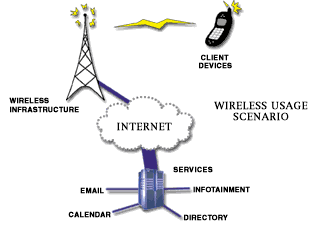 But, unlike traditional GIS users, these new users may not necessarily be GIS users exclusively. Instead, only occasional access — whether local or remote — may be required. As such, the demand for expanded GIS applications that can be most easily facilitated via the Web is increasing daily.
Wireless applications will likely have an easier time being accepted than early GIS systems because unlike GIS (at the time), wireless technology is already pervasive — not just among utilities but in our everyday lives. However, the true productivity gains of wireless technology will ultimately come from driving many of the previously centralized applications to the field operations level for easy access and use by field crews without host system intervention. But, unlike traditional GIS users, these new users may not necessarily be GIS users exclusively. Instead, only occasional access — whether local or remote — may be required. As such, the demand for expanded GIS applications that can be most easily facilitated via the Web is increasing daily.
Wireless applications will likely have an easier time being accepted than early GIS systems because unlike GIS (at the time), wireless technology is already pervasive — not just among utilities but in our everyday lives. However, the true productivity gains of wireless technology will ultimately come from driving many of the previously centralized applications to the field operations level for easy access and use by field crews without host system intervention.
Because of the nature of electric utilities (i.e., assets spread out over an expansive service territory) and the presence of a large mobile workforce, wireless connectivity looms large as a potentially valuable solution set. However, spotty coverage and insufficient bandwidth to support increasingly robust mobile applications continue to impede the advancement of wireless in the utility market. Fortunately, a convergence is taking place between wireless and mobile technology that allows a significant amount of data to be stored in the field device itself and permits wireless access when the latest information is required. Yet while it is clear that utilities want wireless/mobile technology, they are still looking for the mission-critical applications that their field crews will sponsor and use.
Because wireless technology is highly vulnerable to invasive forces, security issues must also be addressed. Indeed, for many users each level of security impacted represents another deterrent to deploying and using the system. Currently, there are three central concerns in the security arena: (1) Stealing data from the airwaves; (2) Stealing bandwidth (for Web surfing or other non-productive activities); and (3) Gaining corporate system access via the wireless connection. Yet although concern #1 is reasonably handled through data encryption; #2 can be easily handled with password protection; and #3 can be overcome through a combination of firewalls, passwords and active device authentication, every level of security remains vulnerable and adds to concerns about broadening user access to the data.
Find out more
To learn more about the GMCS Market Forecast, and how you can obtain the complete study, visit InfoNetrix (www.InfoNetrix.com)
|